
As I was shown the grounds, prior to entering the majestic modern cathedral itself, my attention was arrested by this large monument, erected in memory of an event from 1940, an event I seemed not to know anything about.

So what happened in Katyn? And why are there so many images of memorials about it when one searches in Images?
It is also the subject of a 2007 film by Andrej Wajda. Katyn seems to have haunted the consciousness of a lot of people for a very long time...

from one Australian website come this very short summary:
Katyn: Polish deaths at Soviet hands 1940+. Soviet denial until 1989, and Western complicity in that denial.
www.katyn.org.au/
"Who committed the murders remained a mystery until 1990 when the Russian authorities admitted that it was the Russian Secret police (NKVD), that then spent much time and effort in attaching blame on the Germans." http://www.historylearningsite.co.uk/katyn_wood_massacre.htm
from WIkipedia:
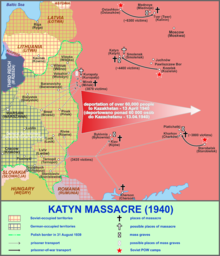
The Katyn massacre, also known as the Katyn Forest massacre (Polish: zbrodnia katyńska, mord katyński, 'Katyń crime'; Russian: Катынский расстрел Katynskij ra'sstrel 'Katyn shooting'), was a mass execution of Polish nationals carried out by the People's Commissariat for Internal Affairs (NKVD), the Soviet secret police, in April and May 1940. The massacre was prompted byLavrentiy Beria's proposal to execute all members of the Polish Officer Corps, dated 5 March 1940. This official document was approved and signed by the Soviet Politburo, including its leader,Joseph Stalin. The number of victims is estimated at about 22,000, with 21,768 being a lower bound.[1] The victims were murdered in the Katyn Forest in Russia, the Kalinin and Kharkiv prisons and elsewhere. Of the total killed, about 8,000 were officers taken prisoner during the 1939 Soviet invasion of Poland, another 6,000 were police officers, with the rest being Polish intelligentsiaarrested for allegedly being "intelligence agents, gendarmes, landowners, saboteurs, factory owners, lawyers, officials and priests".[1]
The term "Katyn massacre" originally referred specifically to the massacre at Katyn Forest, near the villages of Katyn and Gnezdovo (approximately 19 kilometers (12 miles) west of Smolensk, Russia), of Polish military officers in the Kozelsk prisoner-of-war camp. This was the largest of several simultaneous executions of prisoners of war. Other executions occurred at the geographically distantStarobelsk and Ostashkov camps, at the NKVD headquarters in Smolensk, and at prisons in Kalinin (Tver), Kharkiv, Moscow, and other Soviet cities. Still more executions took place at various locations in Belarus and Western Ukraine, based on special lists of Polish prisoners, prepared by the NKVD specifically for those regions. The modern Polish investigation of the killings covered not only the massacre at Katyn forest, but also the other mass murders mentioned above. Polish organisations, such as the Katyn Committee and theFederation of Katyn Families, consider the victims murdered at the locations other than Katyn as part of the overall massacre.[1]
The government of Nazi Germany announced the discovery of mass graves in the Katyn Forest in 1943. When the London-based Polish government-in-exile asked for an investigation by the International Red Cross, Stalin immediately severed diplomatic relations with it. The Soviet Union claimed the victims had been murdered by the Nazis, and continued to deny responsibility for the massacres until 1990, when it officially acknowledged and condemned the perpetration of the killings by the NKVD, as well as the subsequent cover-up.[1][2][3][a]
An investigation conducted by the Prosecutor General's Office of the Soviet Union (1990–1991) and theRussian Federation (1991–2004), confirmed Soviet responsibility for the massacres. It was able to confirm the deaths of 1,803 Polish citizens but refused to classify this action as a war crime or an act of genocide. The investigation was closed on grounds that the perpetrators of the massacre were already dead, and since the Russian government would not classify the dead as victims of Stalinist repression, formal posthumous rehabilitation was ruled out.[4] The human rights society Memorial issued a statement which declared "this termination of investigation is inadmissible" and that their confirmation of only 1,803 people killed "requires explanation because it is common knowledge that more than 14,500 prisoners were killed".[5] In November 2010, the Russian State Duma approved a declaration blaming Stalin and other Soviet officials for having personally ordered the massacre.[6]

No comments:
Post a Comment